
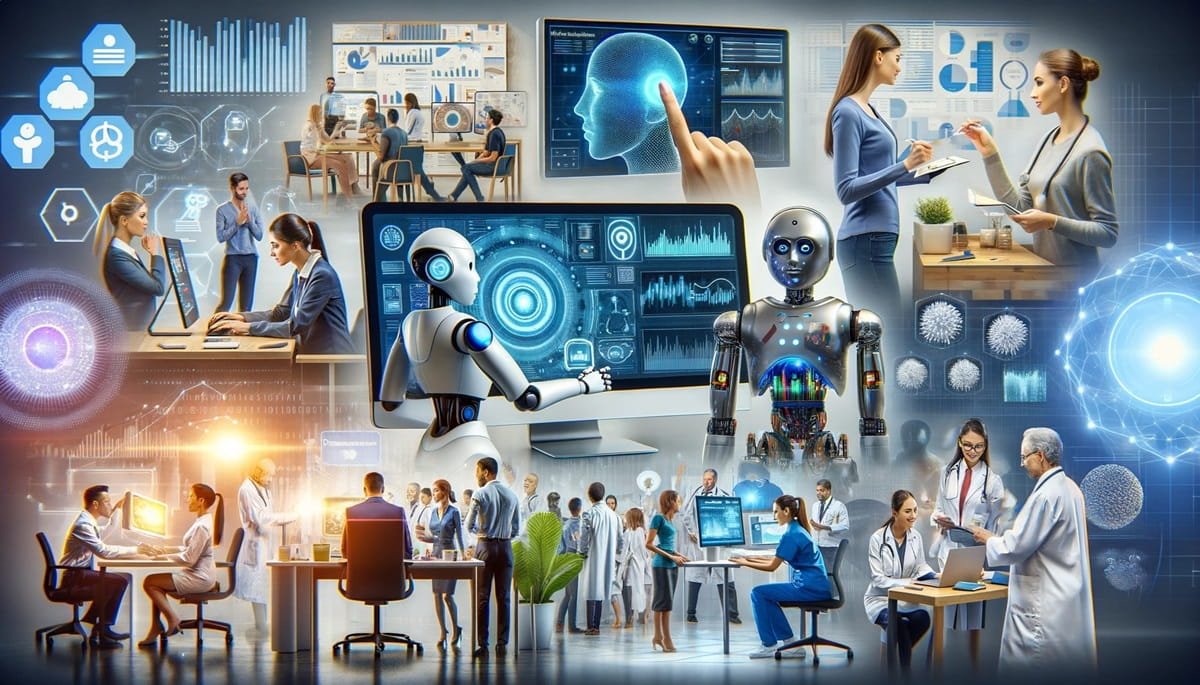
The impact of artificial intelligence (AI) on the nature of future employment is becoming increasingly apparent as it continues to develop. AI is transforming industries and the working environment through automation, augmentation, the emergence of new job categories, and shifting skill needs. AI is giving us the means to keep up with change and take the lead in it. To turn disruption into a chance to create a more effective, just, and significant future, it is necessary to embrace this technology with responsibility and purpose. This article will examine how artificial intelligence (AI) is transforming several industries and changing the nature of labour in the twenty-first century.
How AI Will Impact the Future?
Improved Business Automation
As chatbots and digital assistants become more popular, businesses can now rely on AI to manage straightforward consumer conversations and respond to routine employee inquiries. Making decisions can be sped up by AI’s capacity to evaluate vast volumes of data and translate its conclusions into easily comprehensible visual formats. Using real-time insights, business executives may make well-informed decisions without having to spend time sorting through the data themselves.
New Job Roles and Skill Requirements
Some traditional work functions may be eliminated by AI-driven automation. But it also opens up new career prospects in cutting-edge industries like cybersecurity, data science, AI engineering, and machine learning. As AI develops, the workforce must become more data-driven, emphasizing digital literacy, problem-solving abilities, flexibility, and lifelong learning.
Ethical and Societal Implications
As AI becomes more widely used in the workplace, ethical issues include algorithmic prejudice and data privacy. How AI may affect job displacement and wealth inequality must be addressed. To guarantee that the adoption of AI is morally egalitarian and advantageous for society at large, policymakers, business executives, and educators must work together.
Core Skills in Demand for 2025
Insights from the 2025 research indicate that for employees to thrive in contemporary workplaces. Employers expect them to balance hard and soft talents. Businesses identified as essential soft skills included technical proficiency, interpersonal skills, emotional intelligence, and a dedication to lifelong learning. To satisfy changing industrial expectations, our findings emphasize the increasing importance of matching technical expertise with collaborative and adaptable capabilities.
Use Process Intelligence
Gathering and evaluating data from all of your company’s systems is crucial. Process intelligence provides end-to-end monitoring, data-driven discoveries, forecasts, and development opportunities. In real-time, business process management (BPM) software keeps track of, plans, and enhances work. In addition to saving time and money, automating particular processes improves the experiences of both customers and employees. However, the full potential of robotic process automation throughout the company is necessary to realize the transformative and competitive advantages of intelligent automation. This entails combining RPA with many technologies, including natural language processing, machine learning, and artificial intelligence.
Job Disruption
Naturally, concerns about job losses have arisen as a result of business automation. Employees think AI could handle nearly one-third of their jobs. Even while AI has improved the workplace, its effects on various sectors and occupations have been uneven. For instance, manual professions like secretaries will likely be automated, but there is a greater need for positions like information security analysts and machine learning professionals.
AI will likely enhance rather than replace workers in more creative or specialized roles. AI is expected to encourage upskilling initiatives at the individual and corporate levels, whether it is by requiring workers to learn new skills or by replacing them in their current positions.
Data Privacy Issues
Businesses need a lot of data to train the models that drive generative AI technologies, and this process has drawn a lot of attention. Since OpenAI may have broken European data protection regulations, the FTC has opened an inquiry to determine whether the company’s data collection practices have harmed consumers. This comes amid concerns about businesses gathering personal information about customers.
Increased Regulation
The way generative AI lawsuits develop in 2024 may change how people think about some legal issues. In light of copyright challenges brought against OpenAI by authors, musicians, and businesses such as The New York Times, for instance, the topic of intellectual property has gained significant attention. These lawsuits have an impact on how the American legal system defines private and public property, and OpenAI and its rivals may suffer significant defeats if they lose.
Accelerated Speed of Innovation
Strong artificial intelligence (AI) technology has the potential to accelerate tenfold, where 50–100 years of invention might occur in five–10 years. This argument expands upon the notion that true discoveries are discovered only occasionally. Perhaps once a year, the main obstacle is a lack of skilled researchers.
Challenges and Considerations
These are some possible dangers associated with artificial intelligence.
- Job Losses
Women are more likely than men to be exposed to AI in the workplace. Therefore, not all employees will be impacted equally. When you add in the stark disparity in AI skills between men and women, women appear to be far more vulnerable to job loss. The spread of AI may lead to increased unemployment and fewer prospects for those from underrepresented backgrounds to enter the tech industry if businesses don’t take action to upskill their employees.
- Human Biases
The tendency for AI to reflect the prejudices of those who train the algorithmic models has damaged the technology’s reputation. For instance, it has been reported that facial recognition software discriminates against persons of colour with darker complexions and favours those with lighter skin. AI systems have the potential to reinforce users’ preconceptions and sustain social injustices if researchers are not vigilant in identifying these biases at an early stage.
- Data Privacy
Using public data to train AI models raises the risk of data security lapses that could reveal personal customer information. By adding their data, businesses also increase these dangers. Forty-eight per cent of companies have entered confidential company data into generative AI tools, and 69 per cent are concerned that these tools could harm their legal and intellectual property rights, according to a 2024 Cisco survey. An organization may become susceptible if a single breach exposes the data of millions of customers.
- Deep Fakes and Misinformation
Deepfakes have the potential to cause the public to get confused about what is real and what isn’t, making it difficult to distinguish between fiction and reality. Furthermore, the impact of false information could endanger both individuals and entire nations if people are unable to recognize deepfakes. Among other things, deepfakes have been used to spread political propaganda, perpetrate financial fraud, and put students in precarious situations.
The Future of Work Across Industries
The strategic use of AI by businesses determines its distinctive impact, which has changed from being a differentiating value proposition to an indispensable tool. Here are three essential industries that AI is transforming, along with what lies ahead for their innovation and leadership.
1. Healthcare: Redefining Patient Care Through AI
Everything from patient care to diagnostics is changing as a result of AI integration, which is making the system quicker, more precise, and more individualized. AI models in radiology are reducing the time needed for diagnosis, allowing for life-saving measures more quickly.
2. Transportation: Driving Efficiency and Sustainability
With the potential to transform logistics and mobility, artificial intelligence (AI) technologies are causing a seismic change in the transportation sector. AI is revolutionizing international trade and transportation, from driverless cars to route optimization.
3. Tax and Accounting: From Compliance to Strategic Leadership
AI is transforming tax procedures by automating repetitive chores like filing, data input, and reconciliation, freeing up professionals to concentrate on strategic projects. Large datasets can be analyzed by machine learning algorithms and advanced data analytics to spot trends, predict tax obligations, and improve tax plans. “Chief tax officers are guiding their companies into a new era of growth and opportunity. Tax departments can use data to continue fostering stakeholder trust and exercise strategic influence.
Conclusion:
Artificial Intelligence is undoubtedly transforming the way we operate. It’s making work more intelligent, quicker, and frequently more effective. Although the advantages are apparent, there are also some significant concerns. What happens to jobs when machines take their place? How can we ensure the impartiality and fairness of AI decisions? The fact is that AI is here to cooperate with humans, not to replace us. Thus, we must concentrate on developing abilities like creativity, empathy, and critical thinking that enhance what AI cannot accomplish. People and technology may coexist in the workplace of the future if we are prepared and have the correct attitude.
Frequently Asked Questions
How does AI transform future work?
AI may enable employees to concentrate on the essential components of their jobs that call for human intellect, creativity, and specialized skills by automating repetitive and tedious tasks.
How has AI transformed the world?
AI-powered technologies like computer vision, image and audio recognition, and natural language processing have entirely transformed the way we engage with and consume media. Finding and accessing the information we require is made simpler by AI’s ability to process and analyze enormous volumes of data swiftly.
How is AI changing the world of work?
Artificial intelligence (AI) in the workplace is revolutionizing sectors by increasing productivity, stimulating creativity, and generating new job types. Similar to this, workplace automation has improved efficiency, decreased mistakes, and allowed workers to concentrate on more difficult jobs.
How is AI good for society?
Researchers also benefit from AI. Data collection and analysis take a lot of time for human researchers. By locating relevant material from a global database—a feat that would be nearly difficult for humans to accomplish—AI can now speed up the process for many.
When did AI begin?
They created and popularized the phrase “artificial intelligence.” Notable dates: The Imitation Game, a test of machine intelligence, was developed by Alan Turing in his 1950 book Computer Machinery and Intelligence.