
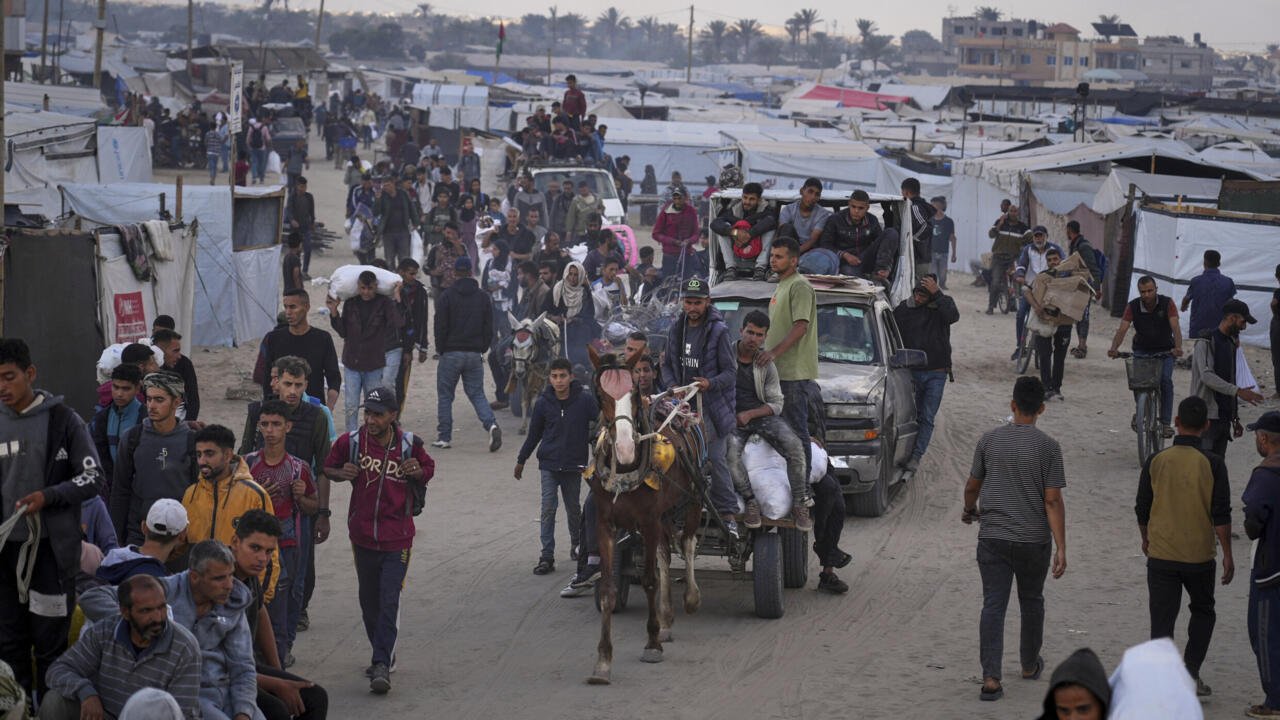
The Gaza Strip, sometimes referred to as just Gaza, is a small region on the Mediterranean Sea’s eastern shore. It is the smaller of the two Palestinian areas that comprise the State of Palestine, together with the West Bank. Gaza, one of the world’s most densely populated regions, is primarily inhabited by Palestinian refugees and their descendants. The population of the Strip is estimated to be 2.1 million by the end of 2024, a 6% decrease from the year before as a result of the Gaza conflict. Israel borders Gaza on the east and north, and Egypt borders it on the southwest. Rafa is currently its largest city, although Gaza City serves as its capital.
What has occurred in the Gaza Strip?
The regions of Israel, Egypt, and the Mediterranean Sea encircle the Gaza Strip. Its length is 41 km (25 miles), while its width is 10 km. One of the most densely populated areas on Earth, it is home to over 2.3 million people.
- Gaza has one of the highest unemployment rates in the world before the most recent conflict between Israel and Hamas.
- A large number of people were relying on food assistance to survive and were living below the poverty line.
- After Gaza was conquered by Egypt during the 1948 Middle East War, its borders were established.
- After Egypt was forced to leave Gaza during the 1967 war, Israel took control of the Strip, establishing settlements and imposing military authority over the Palestinian inhabitants.
- Israel unilaterally withdrew its troops and settlers from Gaza in 2005, but it kept control of the territory’s common shoreline, airspace.
History
At the end of Ottoman authority during World War I (1914–18), the Gaza region was included in Palestine’s League of Nations mandate under British administration. In November 1947, the UN General Assembly approved a plan for the Arab-Jewish division of Palestine, before the expiration of this mandate. The plan designated the town of Gaza and a portion of the surrounding land for the Arabs. On May 15, 1948, the British mandate concluded, and the first Arab-Israeli war erupted that same day. The Egyptian expeditionary army in Palestine swiftly established its headquarters in the town of Gaza upon the arrival of Egyptian forces. Intense combat in the fall of 1948 reduced the Arab-occupied area surrounding the town to a strip of land measuring 25 miles (40 km) long and 4-5 miles (6–8 km) wide. This region became known as the Gaza Strip. The armistice agreement between Egypt and Israel on February 24, 1949, defined their borders.
What was Israel before 1948, and how was it created?
During World War One, after the Ottoman Empire, which had dominated that region of the Middle East, was defeated, Britain seized possession of what is now known as Palestine. Among other ethnic groupings, there was a Jewish minority and an Arab majority. In the Balfour Declaration, the United Kingdom pledged to build a “national home” for Jews in Palestine, further escalating tensions between the Arab and Jewish communities.
Palestinian Arabs opposed the relocation because they had a centuries-old claim to the property, while Jews had historical ties to it as well. The British insisted that the rights of the existing Palestinian Arab residents must be upheld.
- Gaza Strip in Modern History
After Hamas gunmen invaded southern Israel on October 7, 2023, and started murdering and kidnapping civilians, starting a devastating Israeli military campaign that was only recently halted by a precarious ceasefire, Gaza, which has long been a powder keg, detonated. Tensions over the future of the enclave are rising in response to U.S. President Donald Trump’s proposal on Tuesday that the United States take “ownership” of the land and allow displaced Palestinians in Gaza to be permanently relocated outside the war-torn region.
- 1948 – 1967: Egyptian Rule of Gaza
Today, Gaza is a part of the vast region of the Middle East that was ruled by the British before the 1948 war surrounding the creation of Israel. A narrow strip of territory that was positioned between Israel, Egypt, and the Mediterranean was taken over by the Egyptian army after Israel defeated the Arab alliance. Approximately 700,000 Palestinians were displaced during the conflict, sometimes known as the Nakba, or “catastrophe,” from their homes in what is now Israel. The Palestinians poured into the strip in their tens of thousands.
- 1967 – 1993: Israel Seizes Control
The West Bank and East Jerusalem, which are still under Israeli sovereignty, were taken from Egypt by Israel during the 1967 Mideast War, along with Gaza. To establish a future state, the internationally recognized Palestinian Authority, which oversees the occupied West Bank’s semi-autonomous regions, wants all three areas. Over 20 Jewish settlements were constructed in Gaza by Israel during this time. It also signed a peace agreement with Egypt at Camp David, which was mediated by Jimmy Carter, the president of the United States.
When he refused to allow Palestinian refugees from Gaza to enter Egypt, Egyptian President Abdel Fattah el-Sissi cited this 40-year-old pact, claiming that the possible entry of militants would jeopardize the long-standing peace between Israel and Egypt.
- 1993 – 2005: The Palestinian Authority Takes Charge
The future of Gaza appeared reasonably bright for a while due to the promise of peace negotiations between Israeli and Palestinian officials. Gaza was turned over to the nascent Palestinian Authority after the Oslo Accords, a series of agreements between Israeli Prime Minister Yitzhak Rabin and Yasser Arafat of the Palestinian Liberation Organization that established the framework for a two-state solution. With the start of the second Palestinian uprising in late 2000, another attempt at peace fell apart. Then-Israeli Prime Minister Ariel Sharon oversaw a unilateral withdrawal from Gaza in 2005 as the rebellion began to fade, forcing out all of Israel’s troops and about 9,000 settlers in a decision that deeply polarized Israel.
- 2005 – 2023: Hamas seizes power
A few months after Israel withdrew, Hamas defeated Fatah, the long-dominant Palestinian political party, in parliamentary elections. The Palestinian Authority, commanded by Fatah, lost Gaza to Hamas in a bloody takeover the next year, following months of internal strife. The region was placed under a punishing embargo by Egypt and Israel, who kept an eye on the movement of people and goods in and out. In one of the world’s most densely inhabited regions, the shutdown has devastated the local economy for almost 20 years, caused unemployment to soar, and encouraged militancy.
- The Six-Day War
It is the Six-Day War between Israel and a number of its Arab neighbors. Despite suffering seven hundred casualties, Israel emerges victorious, while its opponents suffer close to twenty thousand. Israel comes out on top, controlling all of East Jerusalem and the West Bank and Gaza Strip, which are predominantly Palestinian territories. Israel also seizes control of Egypt’s Sinai Peninsula and the Golan Heights in Syria. The Sinai Peninsula will remain under Israeli control until April 1982.
- The Oslo Accords and the Palestinian Authority
The Oslo Accords were signed in 1993 with the goal of bringing about peace in five years by Israeli Prime Minister Yitzhak Rabin and Palestinian Leader Yasser Arafat. For the first time, both sides were able to identify one another. In 1995, a second deal split the occupied West Bank into three sections, designated as Areas A, B, and C. The Oslo Accords gave rise to the Palestinian Authority, which was given limited authority over 18 percent of the area while Israel essentially maintained sovereignty over the West Bank.
- Blockade of Gaza
After Hamas took control of Gaza in 2007, Israel established a blockade. The siege is still in place today. The West Bank and East Jerusalem—areas that the Palestinians desire to be included in their future state—are also under Israeli occupation. In response to a surprise Hamas attack within Israel, Israel declared a complete blockade of the Gaza Strip on October 9, severing its fuel, food, water, and electrical supplies. That incident claimed the lives of at least 1,200 individuals.
- Israel and Palestine Now
There are currently 1.6 million Palestinian citizens of Israel, and roughly 5 million Palestinians living in Gaza, the West Bank, and East Jerusalem. About half of their population is comprised of this. The other half of the population resides abroad, including in Arab nations. Currently, there are 14.7 million Jews worldwide, with 84 percent residing in Israel and the US. The remainder reside abroad, in places including France, Canada, Argentina, and Russia.
Conclusion:
Since 1948, the Gaza Strip has experienced numerous challenging transformations. It has experienced battles, blockades, and many powers’ domination, making it one of the world’s most unstable regions. Many people have lost their homes, their loved ones, and their sense of security over the years. The inhabitants of Gaza continue to live despite the harsh conditions there. They care for their families, attend school, and hold out hope for a better future. Even though many of them have never experienced peace, they nevertheless long for it. Millions of people live there, and they share the same goals: freedom, peace, and safety.
Frequently Asked Questions
What is the Gaza Strip, and why is it important?
The Gaza Strip is a region northeast of the Sinai Peninsula that spans 140 square miles (363 square kilometers) along the Mediterranean Sea. The Gaza Strip is unique in that it is a heavily populated region that is not officially acknowledged as a part of any nation.
Why did Israel give up the Gaza Strip?
Israeli officials, historians, and legal experts listed several reasons for the country’s decision to leave the region, but the two most important ones were demographic concerns and the unaffordable cost of ongoing, intense combat with Hamas and other Palestinian militant groups.
Why did Israel build a wall around Gaza?
Israel initially built a border fence in 1971 as a security measure, and it has since been reconstructed and improved. Israel built it to regulate the flow of people and goods between Israel and the Gaza Strip, something that regular border crossings were unable to accomplish.
Who controls the Gaza border?
Israel’s military claims to have seized control of the Philadelphia Corridor, a strategically significant buffer zone along the Gaza-Egypt border, giving it total control over Gaza’s land border.
Can Palestinians leave Gaza?
Only extraordinary humanitarian circumstances, especially acute medical situations, permit Gazans to go to the West Bank; marriage is not permitted. Traveling to Gaza from the West Bank is only feasible if the individual commits to moving there permanently.