
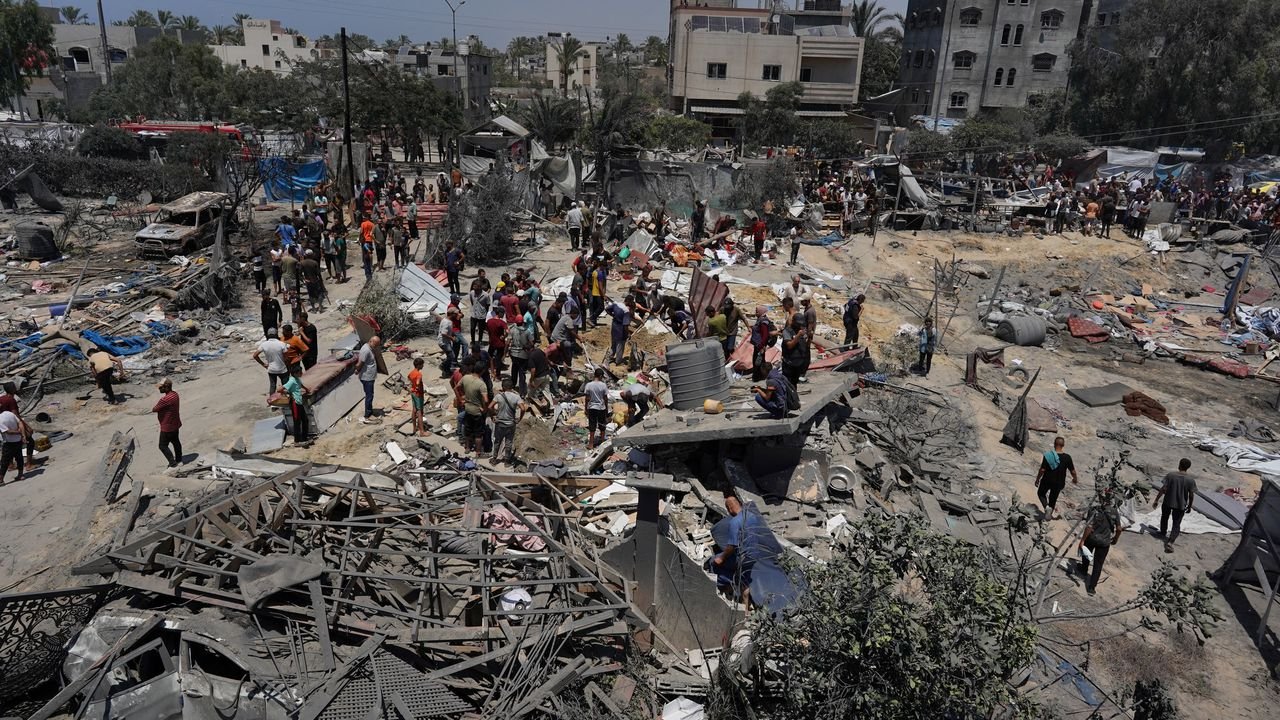
The Israel Defense Forces (IDF) conducted airstrikes and ground operations in the Gaza Strip after Hamas started its murderous onslaught on Israel on October 7, 2023. After 15 months of fighting in Gaza, the United States, Egypt, and Qatar declared on January 15, 2025, that they had brokered a cease-fire between Israel and Hamas. While Israel freed hundreds of Palestinians from Israeli prisons, allowed displaced civilians to return to northern Gaza, and enabled 600 humanitarian aid trucks to enter the region daily, Hamas freed thirty-three of the remaining hostages. But on March 18, Israel ended the six-week cease-fire with a flurry of airstrikes and ground operations in central and southern Gaza.
Israeli-Palestinian Conflict
The Israeli-Palestinian conflict began toward the close of the 1800s. Resolution 181, also referred to as the Partition Plan, was enacted by the UN in 1947 to create Arab and Jewish states out of the British Mandate of Palestine. The first Arab-Israeli War began on May 14, 1948, when the State of Israel was established. Israel won the war in 1949, but 750,000 Palestinians were forced to flee their homes, and the land was split into three sections: the Gaza Strip, the West Bank (of the Jordan River), and the State of Israel. Tensions in the area increased during the ensuing years, especially between Israel and Jordan, Syria, and Egypt.
Ongoing Conflict and Related Issues
Israeli Prime Minister Benjamin Netanyahu has repeatedly stated that Israel seeks “total victory” over Hamas, including by destroying Hamas’s military and governing capabilities in Gaza and recovering all hostages. Debate has ensued among Israeli officials and citizens about these objectives and possible tension. War cabinet minister Benny
Gintz claimed that Prime Minister Netanyahu had not adequately prepared for a post-war transition when he resigned and quit the ruling coalition in June 2024. Yadav Gallant, the minister of defense, has demanded an agreement that would permit the return of some captives and at least halt hostilities for six weeks.
What is Hamas, and what are its goals?
In 1987, Hamas was founded as a division of the Muslim Brotherhood. The Islamic Resistance Movement is what its name signifies. In its place, as well as in the occupied West Bank, East Jerusalem, and Gaza, it seeks an Islamic state.
However, without denying its claim to all of historic Palestine, it has indicated that it is willing to accept an interim Palestinian state in only the West Bank, East Jerusalem, and Gaza. Israel claimed in August that its forces had killed over 17,000 Hamas fighters, compared to an estimated 30,000 before the October 7 attacks. There is no way to confirm this independently.
Since 2007, Hamas has ruled the Gaza Strip alone after capturing the Palestinian elections and ruthlessly overthrowing its opponents.
Hamas Attacks Israel
The deadliest attack in Israel’s history was carried out by Hamas, which killed over 1,200 people, including over 360 youths, during a music festival. The country was rocked by the unprecedented incident in which Hamas terrorists abducted hostages and spent hours targeting border communities.
According to Hamas, it is a resistance movement. As a reaction to what it claims are decades of Israeli oppression, Palestinian deaths, and the siege of the Gaza Strip, it has explained the attack. Al-Hayya defended the attack as Israel was ready to commemorate a year since it occurred, claiming that it had elevated the Palestinians’ predicament to a global political priority. It was necessary to raise an alarm in the world to tell them that there are people who have a cause and have demands that must be met.
Israel’s Response to Hamas’s Attacks
The strike on October 7 sparked Israel’s massive military offensive against Hamas in Gaza. After a series of airstrikes, a ground invasion took place. Israeli Prime Minister Benjamin Netanyahu stated that Israel’s objectives were to eliminate Hamas, free the hostages, and ensure that Israel would never again be a threat. After Hamas ally Hezbollah attacked northern Israel, close to the Lebanon border, the Israeli government also stated that it wanted tens of thousands of displaced Israelis to be allowed to return to their homes.
Military-based Storm
The Israeli security apparatus was unprepared for the simultaneous attacks. Both military and civilians were left to fend for themselves for many hours. Along the Israeli-Gaza Strip border, the strikes moved from north to south. The Israeli army admitted that armed Palestinians had breached at least three military locations. There was fierce fighting. Several Hamas propaganda photos later revealed that automatic guns, rocket launchers, and grenades are used to attack the bases.
In some cases, the fighting woke Israeli soldiers from their slumber. In Nahal Oz, at least fifty soldiers, many of them unarmed women, were slain. The Gaza Division’s headquarters, the regime’s military base, was also taken. Israeli soldiers did not take it back until the conclusion of the day.
Gaza Strip in Maps
The Israeli kibbutz is undergoing healing. According to Gaza’s health ministry, which Hamas manages, the war has killed over 46,700 people, the majority of them civilians, most of them women and children. There are “catastrophic” levels of food insecurity, according to the UN, and the majority of the 2.3 million people have been displaced.
Hamas fighters cross the border.
The purpose of the rockets was to conceal the well-planned Hamas commando invasion. Hundreds of combatants from the al-Qassam Brigades, Hamas’s armed branch, made their way to dozens of locations along the 59-kilometre border between Israel and the Gaza Strip. The Israeli watchtowers with machine guns on top were destroyed by drones equipped with explosives close to the Gaza border.
Gaza Transition Planning
Although they will probably face some political, security, and logistical challenges in preventing a Hamas resurgence, establishing law and order, and achieving long-term recovery, US officials have attempted to collaborate with Israeli, Palestinian, and some Arab governments to plan for a transition of governance and security in Gaza. US officials have supported the PA to resume its administration in Gaza following specific changes as part of attempts to advance toward a two-state solution. The PA and other Arab leaders insist on progress toward a Palestinian state during this transition. Israel should have “overriding security control” in Gaza and complete security control over “all territory west of the Jordan River,” according to Prime Minister Netanyahu, for the “foreseeable future.”
Israelis Hold Memorials and Call for the Return of Hostages
Israelis remembered the hundreds of victims, the dozens of hostages still in captivity, and the troops slain in combat by flocking to ceremonies, cemeteries, and memorial sites across the nation. In Europe and beyond, commemorations were also planned.
The location where at least 364 revellers were slain and numerous others were taken hostage was visited by hundreds of families of those killed at the Nova music festival before morning, joined by President Isaac Herzog. The same hypnotic song playing as the sun rose was suddenly cut off when the rocket volley started.
Conflict, humanitarian situation, and international action.
The health ministry in Gaza, which is under Hamas control, reports that over 41,000 Palestinians have been killed in the battle thus far. 90% of Gaza’s 2.1 million inhabitants have also been relocated, and the majority are living in filthy, crowded conditions with severe shortages of food, water, healthcare, and other necessities. High levels of food insecurity have been exacerbated by barriers to safely delivering relief via crossings and Israeli checkpoints. As of August 2024, the Famine Early Warning Systems Network (FEWS NET) stated that while humanitarian assistance was likely averting famine, “hunger and malnutrition remain dire, and hunger-related mortality is likely still occurring.”
Forced Displacement
The Israeli military has issued more than 65 evacuation orders since October 7, 2023, leaving about 80 percent of the Gaza Strip under active evacuation orders.
Frequently asked questions
- What is the dispute between Israel and Hamas?
The Israeli occupation, blockade of the Gaza Strip, settler violence against Palestinians, restrictions on Palestinian movement, and the imprisonment of thousands of Palestinians, whom Hamas attempted to free by capturing Israeli hostages, were cited by Hamas officials as the reasons for the attack.
- Who funds Hamas?
Along with the money it receives from Iran, Hamas’s international investment portfolio brings in enormous quantities of cash from its estimated hundreds of millions of dollars worth of assets, which include businesses in Sudan, Algeria, Turkey, the United Arab Emirates, and other nations.
- Who is helping Palestine right now?
Families of Palestine refugees are currently depending on UNRWA and you to support them during unspeakable adversity. Your contribution guarantees the delivery of food, the care of children, and the survival of hope. We can maintain this lifeline if we work together.
- How many Hamas fighters are there?
Before October 2023, HAMAS had between 20,000 and 30,000 fighters. According to the Israeli news, between 16,000 and 18,000 fighters are still alive.
- Who funds Hezbollah?
According to Israeli reports, HAMAS had between 20,000 and 30,000 fighters before October 2023. Between 16,000 and 18,000 fighters are still alive.
the survival of hope. We can maintain this lifeline if we work together.