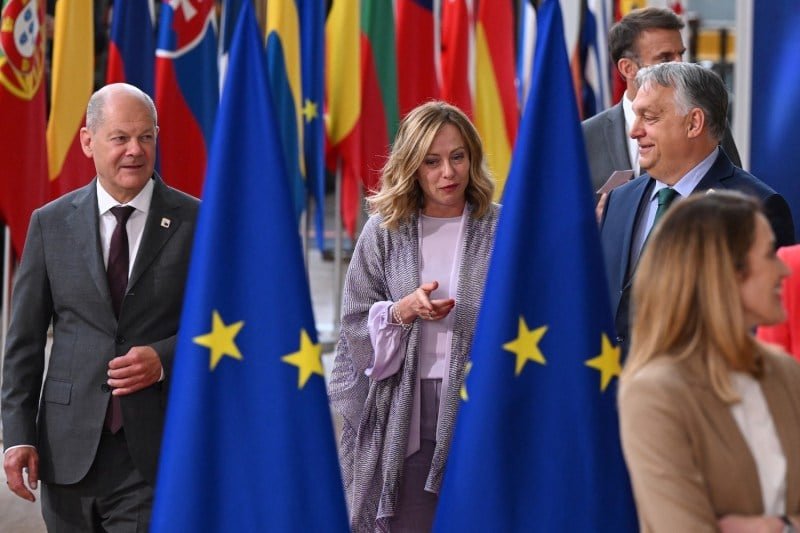
The European Union (EU) member states have mainly divided into three groups since October 7. Hamas attacks and the beginning of Israel’s offensive response in the Gaza Strip. Those who have declared themselves to be “on the side of Israel”—flying the Israeli flag on government buildings, supporting its military assault, and ignoring criticism. Even after the Israeli army murdered hundreds of Palestinian people and leveled much of Gaza, they are at one extreme. On the opposite end of the spectrum are nations that identify as being “on the side of peace. They publicly denounce Israel for its violations of international humanitarian law and advocate for a ceasefire while vehemently denouncing Hamas. To call the moderate camp “pro-Palestinian” would be incorrect. The truth is that there isn’t a pro-Palestinian faction among EU governments. Unlike several nations in the so-called Global South, none of them have raised Palestinian flags or mainly denounced Israel’s occupation and its catastrophic Gaza offensive. Deputy Prime Minister Yolanda Díaz of the left-wing Sumar party in Spain. Those who have condemned “Israeli apartheid” and demanded sanctions and an arms embargo on Israel. It may be the sole outspoken exception. Her remarks do not, however, reflect the stance of the entire government.
Encouraging rather than Restraining Israel:
The balance of power between the moderate, in-between, and Israel-aligned camps has produced the EU’s overall stance. The positions of the Israel-aligned group are closer to the common EU statements. This is due to the latter’s increased capacity for blackmail. Suppose common positions include any overt criticism of the Israeli operation. The hardliners are willing to prevent their adoption completely. To hide the vast divide between those who think Israel is committing war crimes and those who believe its actions are unassailable. Diplomats writing the joint statements have devised a compromise language that affirms. “Israel’s right to defend itself in line with international law.”
Divisions among EU Leadership:
The crisis has caused divisions not only among member states but also among the EU institutions’ leadership. Ursula von der Leyen, a German Christian Democrat president of the European Commission, has personified the Israel-aligned approach. In the days following October 7, she visited Israel to express the same unqualified support. Emphasized Israel’s “right to defend itself, today and in the days to come” and projected the Israeli flag on the Commission’s headquarters. Something that had previously only been done in Ukraine. Israel’s relentless bombing assault in Gaza had killed close to 2,000 Palestinians at the time of her visit.
Moral and Strategic Failure:
A sizable portion of Europe’s political class is compelled to support Israel due to more subtly expressed animosities toward Arabs and Muslims, as well as a sense of historical duty and civilizational commitment. At the expense of international conventions, European material interests in regional security, and even compassion for Palestinian lives. Typically, the Israel-aligned populace uses moral arguments to justify their support for the Gaza offensive. But along with the righteous moral outrage at Hamas’s cruelty comes a startling moral indifference about Palestinian suffering. The historical responsibility for the Holocaust also serves as justification for the alliance with Israel, particularly in Germany and, to a lesser extent, throughout Europe. This invocation is perfectly justified in and of itself; the worst Jewish massacre since the Holocaust occurred on October 7.
Europe is divided on the Israeli-Palestinian conflict:
The situation is quite different when it comes to the Israeli-Palestinian dispute. There are significant differences in how each Member State views this conflict. Historical background, particularly the aftermath of the Shoah, the darkest period in European history, is primarily to blame for this. However, the European Council has come to a minimal agreement among Europeans. This indicates that we should ask for humanitarian pauses rather than a ceasefire. Israel has the right to defend itself in line with international law. Nevertheless, our cohesiveness faltered twice when resolutions urging a ceasefire were put to a vote at the UN, undermining our standing abroad.
Ukraine vs Gaza:
Global South to support the Western stance on the war in Ukraine has been canceled due to Western support for the Gaza conflict. When the West deviated from the same standards in Gaza, it squandered efforts to persuade the world. The United States and Europe’s backing for Ukraine against Russian aggression. It is founded on universal principles of international law rather than the geopolitical ambition of the West.
The Israel-aligned side compares Israel and Ukraine as two Western democratic friends under attack. At the same time, the moderate position emphasizes the necessity of coherence based on international law.
A remarkable European response to the war against Ukraine
Fortunately, an agreement was reached swiftly in the case of Ukraine. The Russians had planned to invade Ukraine before the start of the war. If we had assisted them, it would have been by supplying weaponry so the Ukrainians could protect themselves rather than by sending troops. At the time, Europe’s response to the war in Ukraine was indeed extraordinary, first, despite a 40% reliance on Russian gas. We significantly reduced our energy reliance on Moscow, which once appeared to be nearly impossible.
Cracks in EU Foreign Policy:
The EU has previously made its internal disagreements over Middle Eastern problems public. However, this is perhaps the time when these differences could have a more significant effect. First of all, the war in Gaza has gotten out of hand, killing over 35,000 Palestinians in the first six months of the conflict. The vast majority of them were women and children. The second reason is that EU leaders have made it obvious where they stand on this issue and have frequently taken opposing positions, which has further emphasized the perception of divisiveness. The third reason is that the outside world has observed the weaknesses in EU foreign policy, affecting how they evaluate future ties with the EU based on European stances on current issues.
Nostalgic EU:
There is a nostalgic yearning for a time when the European Union stood united and had a positive influence on the Middle East. Reflecting on its participation in the region, the EU was able to heal gaps between member states with different viewpoints by balancing those who supported the Palestinian or Arab cause with those who had deeper links to Israel. It also found a middle ground between those who wanted the EU to be proactive and take a distinct stance from the US transatlantic alignment.
Reacting to October 7:
There was a great sense of sympathy and camaraderie with the victims of the October 7 terrorist assaults. European institutions and politicians responded clearly and unambiguously. In a statement issued on the same day as the terrorist attacks, the High Representative of the European Union called for “an immediate cessation. It will only further increase tensions on the ground and seriously undermine the Palestinian people’s aspirations for peace,” and denounced. In the strongest possible terms, the multiple and indiscriminate attacks across Israel by Hamas. In the face of such violent and indiscriminate attacks, the EU stands in solidarity with Israel, which has the right to defend itself in line with international law.
Europe between the two wars:
The Russian campaign of aggression against Ukraine and the conflict that has lately erupted. The Middle East is two deadly conflicts that are raging on our borders and taking center stage on the European agenda. I won’t discuss crucial foreign policy concerns like our relationship with China. The effects of climate change, or the tensions in the Sahel, will be concentrated on the impact of these wars on Europe. Europe’s security would grow in importance. For this reason, we started creating the Strategic Compass, a new plan for our shared security and defense.
Europe is in Danger:
Many folks at the time believed that I was exaggerating. They saw it as a marketing gimmick to “sell” the Strategic Compass. The majority of observers continued to hold the view that Russia was only using its forces around Ukraine’s borders. To pressure the West and secure additional concessions, do this. Regarding the Middle East, the same sentiment was prevalent. President Biden’s security adviser, Jake Sullivan, stated in September last year. It had rarely been so calm.” I was constantly told not to get involved in the Israeli-Palestinian conflict.
Conclusion:
The European Union should play a bigger role in the area. The EU has used a variety of mitigation strategies in its attempts to manage the complex constraints related to the Israel-Palestine conflict. If Arab nations agree and are trusted by the Palestinian Authority and Israel, then the answer is yes to a greater role for them. Arab countries aren’t yet prepared to talk about the day after the conflict. They need to be sure that their participation will be a step toward a Palestinian state rather than an aim in and of itself. We must contribute to the establishment of a fully independent Palestinian state that can restore Palestinian dignity, negotiate peace with Israel, and ensure Israel’s and Palestine’s security.
Although the current state of affairs has undoubtedly made this option more challenging to implement than thirty years ago, it is still the only practical means of achieving regional peace. Thus, this must be our objective and our pledge. Otherwise, a cycle of violence that is repeated from funeral to funeral and from generation to generation would begin.
Frequently asked questions
What is the EU’s stance on Palestine?
The EU is the most significant source of foreign funding to the Palestinian Authority and a member of the Quartet. Israel and Palestine are recognized internationally in Europe, and the State of Palestine is recognized by eleven of the twenty-seven EU members.
What is the EU’s opinion on Gaza?
Opinions inside the European Union continue to differ. Some of the most vocal opponents of Israel’s activities in the Gaza Strip include Belgium, Ireland, Luxembourg, and Spain. Spanish Prime Minister Pedro Sánchez has called for international recognition of the Palestinian State “before July [2024]”.
What is the EU’s mission to Palestine?
The European Union has allocated €1.177 billion for Palestine over several years under the European Joint Strategy 2021-2024. By paying the salaries and pensions of some civil personnel in the West Bank, the EU is assisting the Palestinian Authority in covering its ongoing expenses.
What is the goal of Palestine?
Instead of a radical redrawing of borders, the objective was similar to imposing regime change in Israel. Additionally, the Palestinian National Council demanded more autonomy from Arab regimes.
Who attacked first, Israel or Palestine?
On the eve of May 14, the Arabs launched an air attack on Tel Aviv, which the Israelis resisted. The invasion of the former Palestinian mandate by Arab armies from Lebanon, Syria, Iraq, and Egypt followed this action. Saudi Arabia sent a formation that fought under the Egyptian command.